Monday, December 18, 2017

Mykola Kulish


"Every one of us lives for ages, because we, above all, are ideas," wrote the prominent Ukrainian writer, playwright, director and public figure Mykola Kulish. Today we mark the 125th anniversary of his birth.

Mykola was born in Chaplynka (now Kherson region), in the hired family. The boy has been hired as well, he has been in work for 5 years. Soon Mother of Kulish died, his father married for a second time, began to drink. Nicholas lived in the shelter. He was very capable of studying, his teacher noticed it and decided to raise money in order to send the boy to study. He found 100 rubles, thanks to which Kulish went to Oleshkovsky College. There he began to write, but for that he was expelled - satirical verses by Nicholas did not please the leadership of the school.

Nicholas settled in the room in the family of the Nevells, felt in love with their daughter Tosya and subsequently married her. She gave him two wonderful children - the daughter Olga and the son Volodymyr.
Kulish, who was 22 years old, sent documents to the Odessa University to the Faculty of History and Philology. He was enrolled to the first year. However, the boy had to study at the Odessa School of ensigns, because the First World War began. Military service Mykola carried in Smolensk, hit the front. During the war he was injured, got contusion. Kulish returned home as a completely different person.
In 1925, together with his family, Mykola moved to the main cultural center - Kharkiv. There lived in the house for young criminals. Because of this, by the way, homelessness has also become one of the themes of his work.

In Kharkiv, Kulish met with the most famous Ukrainian writers, including Ostap Vyshnya Mykola Khvylovy, Arkady Lyubchenko. Yes, probably, the most important was the meeting with Les Kurbas. Together they created a new Ukrainian theater.

Their creative tandem was extraordinary, the knowledge of Kurbas and the intuitive feelings of Kulish allowed to create masterpieces. For example, the play "97".Everyone was impressed by their thoughts and ability to show their soul through the theater, to feel the images.
In addition, in Kharkiv Kulish was engaged in social activities, in 1926 he headed the literary organization VAPLITE (Free Academy of Proletarian Literature), edited its magazine. He was also the editor of the "Prolitfront" and "Literary Fair".
Mykola Kulish was extremely worried about the fate of his people: "Hundreds, thousands, and tens of thousands of Ukrainians swore at Shevchenko's image not to fold, until Ukraine is free to be restored," he wrote. On the man during the Holodomor of 1933, Antonina Kulish recalled: "I saw that hunger destroys my child (daughter Olga) and asked Mykola to get somewhere to buy some food. Nicholas answered me: "What is Olga ?! When all people, all of Ukraine are dying from starvation? "He did not think about me or about children. He forgot about himself, barely moving his legs: he was exhausted to the edge. "
At the same time, an ideological campaign was launched against Kulish, and the plays “People Malachi”, “Mina Mazaylo”, “Pathetic Sonata” were called hostile to the communist regime.

The last product of Kulish was "McLenna Grace." Socio-psychological drama narrated about the confrontation between man and society. Unfortunately, for Nikolay this confrontation was solved. On December 7, 1934, he was arrested and sentenced to 10 years imprisonment with the confiscation of property. He was ill with tuberculosis under arrest. But he died not from it.
Together with Kurbas - his friend, he was shot on November 3, 1937 at the Sandarmokh tract.

"We want the nation not to clean our foreign boots. Time! It's time to become free! "- called the Ukrainians Kulish. So many decades have passed, and his words remain relevant for us.

Friday, December 15, 2017

HANUKKAH


HANUKKAH - THE LOVE OF THE WORLD, LIGHT AND GOOD

To share a part of miracle with children, we held the Hanukkah holiday at the Honorary Consulate of the State of Israel in the Western region of Ukraine, located in Lviv.

It is important for children to respect their traditions and teach history. Rabbi Siva Fainerman skillfully in game form told the kids about the miracle of Hanukkah and with them lit a third Hanukkah candle.

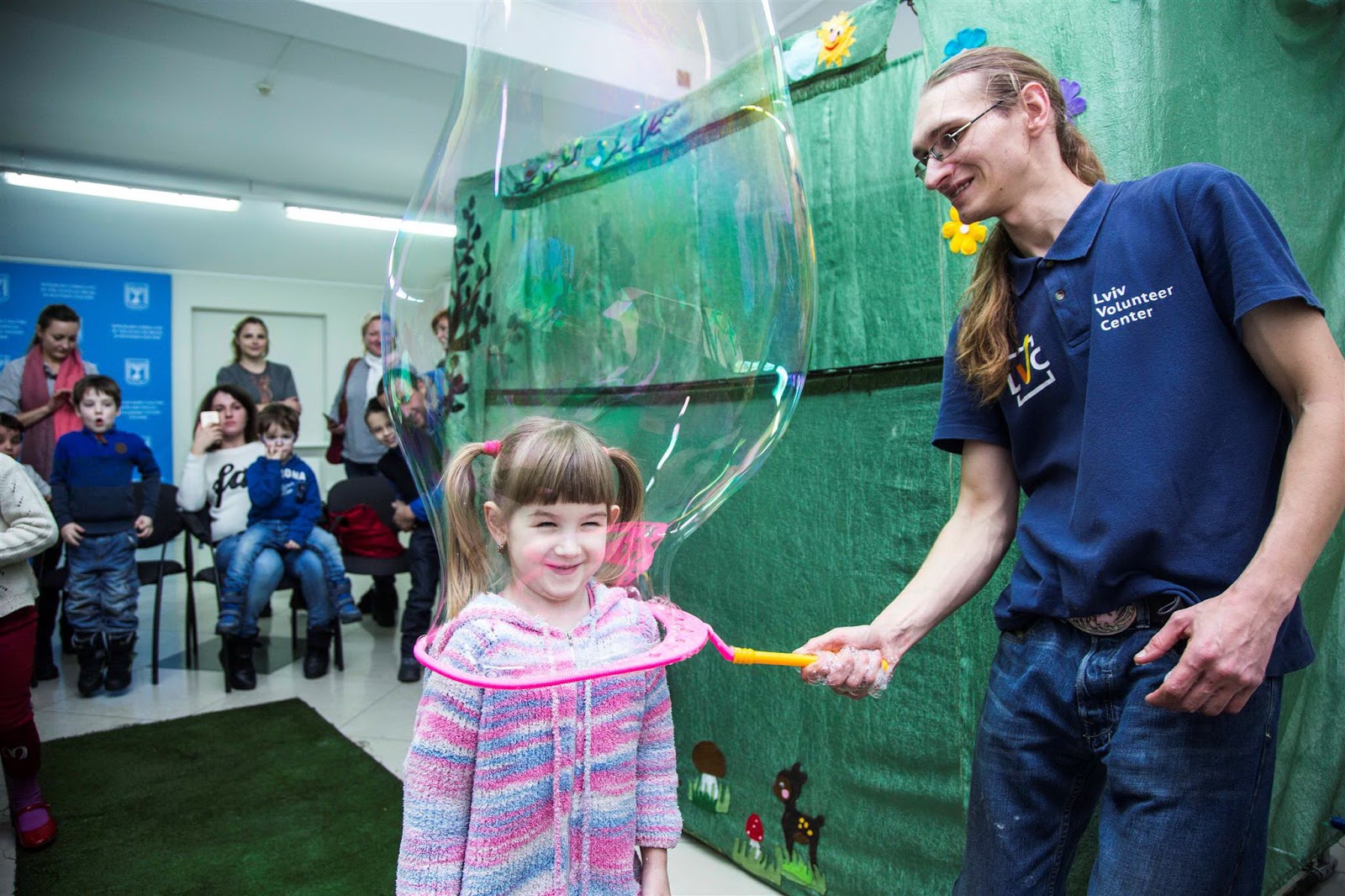
Holiday without surprises - is not a holiday! Therefore, the doll theater called the "Valley of fairy tales" performed with the play about eternal values ​​- kindness, friendship, support and love for parents. And especially the kids were delighted when everyone was "immersed" into a huge so-called "home", during the show of bubbles.

Parents have to give a lot of their own forces in order to raise their child a decent, human-loving, honest and kind person. Holidays make it possible for us, in an easy and unobtrusive way, to lay the foundations for the development of the children.

For example, on Hanukkah, children traditionally are given some money. In Yiddish, this is called "Hanukkah Gelt" - Hanukkah money, in Hebrew - "Dmyh Hanukkah". With this money child can do what he wants - immediately buy something for himself or postpone for the future.

But there is one indisputable obligation - a part of the money should be paid on charity. So even the youngest children are taught to help those who need it. Because there are always people who do not have money for gifts and holidays.

Children are our future!

May your warmth and kindness live in your hearts!

Hag Hanukkah sameah!


Thursday, December 14, 2017

Mykhailo Starytsky


"How I love you sadly
My people are nullified by poverty
Frustrated and darkness is overwhelmed
That has already forgotten how to respect itself
Having spent its former strength ...
How do I love your sad graves
Ukraine! How I love you! "

These strong words in 1878 were written by prominent Ukrainian writer, actor, director, theater and public-cultural activist Mykhailo Starytsky. He was born 177 years ago in the village of Klishchyntsi (now Cherkasy region).

Mykhailo Starytsky is the author of over 30 plays, including the drama «Bohdan Khmelnytsky», «Marusya Boguslavka», and others. In addition to the original plays, he reworked the works of other authors according to the stage rules. For example, “Christmas Night", "For Two Hares", "Limeryvna", and others. Thanks to Mykhailo Starytsky these works became extremely popular among the audience.

Mykhailo Starytsky was born in a gentry family. His father was a retired captain, and his mother came from an outstanding Lysenko family. When the boy was 8 years old, his Dad died. At age 12 he was left without a mother. The mother of Starytsky was brought up by mother’s brother Vitaliy, the father of composer Mykola Lysenko.

Mykhailo's life was associated with Mykola Lysenko. Together with him he was brought up, together they joined the Kharkov University, and with him in 1871 he began to work on the creation of the "Society of Ukrainian Stage Actors" in Kyiv. Mykhailo wrote folk songs, which later he gave tothe work of Nikolay Lysenko, he wrote a libretto to Lysenkov's operas ("Garkusha", "Chernomortsy", "Christmas night", "Taras Bulba", "Drowned").

In 1861, Starytsky returned to his native village to obtain a paternal estate. Then he first fell in love. On the evening parties, the villagers Stepanida struck him. He went to the girl's father to asked for a date, but she was betrothed. Staritsky devoted Stepanida the lines:

"The night is, Lord, lunar, clear, stellar, it is visible, even though you need to collect pines. Come here, my beloved, working hard, at least for a moment in the grove ... ".

These words Mykola Lysenko put on music, but this song started to be famous with the melody of Andriy Voloshchenko and Vasyl Ovchinnikov. Now it is generally considered popular.

The unlucky love of Starytsky was treated by sister of Mykola Lysenko, Sophia. She was only 14 years old when they got married. The couples had 5 children.

In 1882 Starytsky organized the first Ukrainian professional troupe along with Marko Kropyvnitsky. Ivan Marianenko, the prominent Ukrainian actor, recalled: "Having invested all his money in the business, he immediately set the work of the theater on a broad foot: he raised the acting rates to the level of Russian theaters, gathered a large orchestra and a choir, beautifully arranged the plays, invited the best decorators; New costumes and stamped beads were sewn."

The development of the Ukrainian theater was a matter of Mykhailo Starytsky’s life. He spent all his wealth and savings on it. The theater was the life of Starytsky. To put the first Ukrainian professional corps on a high level, he sold his own estate and a bakery... Starytsky was invited to the theater primarily as a patron, and he completely fulfilled his noble mission. Already in the elderly, a prominent theatrical figure has said: "I burst into the theater all my possessions, goodness and in my old age I remained a beggar..."

In 1895, Mykhailo Starytsky left the theatrical activity and was engaged only in literature. Mykhailo Starytsky died in Kyiv on April 27, 1904, buried at Baykovoye cemetery

Jerusalem


Yesterday the Organization of Islamic Cooperation recognized Jerusalem as the capital of Palestine.

In particular, Turkish President Recep Tayyip Erdogan called on the international community to recognize the Palestinian state and proclaim Jerusalem the capital of this "occupied by Israel" country.

To say that it's a nonsense is not to say anything. Recognizing Jerusalem as the capital of Palestine is all the same as proclaiming Paris the center of Zimbabwe or the people of Kiev to "collect suitcases" and recognize the jurisdiction of Honduras.

Such decisions are no more than manipulation in their own interests. This is simply Erdogan's miserable attempt to hold the electorate to his side on the eve of the election.


For its long history Jerusalem was at least twice destroyed, many times captured and attacked. And it will survive this "attack". Jerusalem is the capital of Israel. It was so three millennia ago, and so it will always be

Wednesday, December 13, 2017

Nikolay Leontovich


140 years ago, the Ukrainian composer Nikolay Leontovich, the author of "Shchedryka" processing, who conquered the whole world under the title "Carol of the Bells", was born! In honor of the birthday of the great maestro, I will tell you a few facts about his life and the history of the legendary work.

1. Mykola Leontovych was born in the village of Monastirok, which is in Vinnitsa region. The boy's father was a village priest, but he knew how to play many instruments and taught his son to play cello, violin, guitar, poetry and balalaika. The mother of composer Maria Yosypivna was a woman of "unique spiritual and physical beauty," sang well, taught the son some folk songs. The boy did not only sing, but also conducted a peculiar chorus consisting of brothers and sisters.

2. Parents wanted Mykola to be a priest. After graduating from the Shargorod bourse he studied at the Kamyanets-Podilskyi Seminary. But Mykola still loved music, he started self-education. After graduating from the seminary, he worked as a teacher of a village school in Chukovo, where he organized a choir, an orchestra, and attracted students there. He bought instruments for his own money. With a monthly salary of 27 rubles, for each instrument he gave 25-40 rubles. Than Leontovych composed his "First collection of songs from Podillya" and worked on "The Second Collection of Songs from Podillya."

3. For several years, Leontovych has been a teacher of chants in the Donetsk region and Podillya. During the 1905 revolution, Leontovych organized a chorus of workers who sang at rallies. This attracted the attention of the police, because of which Leontovych was forced to leave.

4. A significant part of his life (Leontovych lived only 43 years), the composer put on work on "Shchedryk." The first author's edition appeared in 1901, the latter - 1919. For the first time, "Shchedryk" was performed by the choir of Kiev University in 1916, and in 1921 it was heard in the USA - the work was performed at Carnegie Hall in New York. The world famous "Carol of the bells" appeared in 1936. Then an American of Ukrainian origin, Peter Wilkhovsky, created the English version of words. Since then, the whole world has known the Ukrainian "Shchedryk" under the name "Carol of the Bells". You can hear the legendary song in modern films, including "Home alone", "Harry Potter", "The Hard Nut" and others. "Shchedryk" became an integral attribute of Christmas holidays.

5. The prominent Ukrainian composer was killed on the 23d of January, 1921, when he came to visit his father. For many years, this information was concealed, but now it is known that the killer of Leontovych was a Chekist Athanasius Gryshchenko, who asked to stay in his father’s house for a night. In the morning, he robbed the house and shot Mykola Leontovych. The text of the report revealing the name of the killer of the composer was made public only in the 1990s.

In addition to "Shchedryk", Leontovych made 150 wonderful works, among which such famous as "Dudaryk", "Pryala", "Kozak carry". Be sure to turn on one of them today to enjoy the immortal talent of the great Ukrainian composer!


Tuesday, December 12, 2017

Joyful holiday of light!


Friends! Today, with the first star, Hanukkah's holiday will begin!

Its story dates back to ancient times. Syrian king Antiochus IV in 167 BC condemned Judaism. The Torah became a forbidden book, following Jewish laws - a crime. Moreover, the two Jewish women and their babies, for whom they secretly made the circumcision, were executed. Because of this, a Jewish uprising broke out. The army was small, poorly equipped. However, it only took them three years to dislodge Antioch with his troops from their lands. After the control on Jerusalem was established by the army of Judah Maccabee, the Jews managed to restore the Second Jewish Temple.

On the day of his consecration it was necessary to light the menorah and maintain its fire. But there was no olive oil for the lamps, only one jug was left. And manufacturing of a sufficient number could take eight days. But the Jews still decided to light the candles. And they had burned on that oil for 8 days, instead of one. It was just a miracle! Therefore, the wise men decided that, starting from the 25th day of Kislev, within 8 days, the Jews would have days for joy and fun, they have to pray and read Galeel, and light candles.

The holiday was called Hanukkah, which means "a solemn opening, a sanctuary." This day, the worship was restored at the Temple of Jerusalem. Another explanation of the name - "Hanu" means rest, "kkah" - 25th day of the month kislev.

At Hanukkah family gather at the big family table and chic meal. People sing traditional songs and talk about the miracles God has made for ancestors. They eat donuts with jam, called sufganite and, imagine, derynu! But they are called "latkes". Kids are on vacation, so they love the holiday. According to tradition, the children are given a lot of toys and money, some of which they have to pay for charity.

Friends, there is a wise Jewish saying: "A little light is enough to dispel the great darkness." In this great holiday for the Jewish people, I urge you never to be disappointed and not destitute. Miracles are very close to us; we just need to believe, and they will come true.


Hag sameah! Joyful holiday of light!

Monday, December 11, 2017

Israeli Friends of Ukraine


"You exist at the expense of what you get. You live when you give, - Winston Churchill said. On Sunday, I had the honor to read a lecture to the people who really live - Ukrainian and Israeli volunteers. Public organization Israeli Friends of Ukraine on the 10th – 11th of December held a seminar is held on the topic of cooperation between volunteer and public organizations of Israel and Ukraine.

I saw the most loyal people from all corners of Ukraine: from Vinnitsa, Kharkov, Odessa, Zhitomir ... And also people with a big heart from Israel who sincerely want to help Ukrainians. The purpose of the event was the development of joint projects and their launching in Ukraine.

I sincerely support such initiatives, because I am sure that the eternal bond of our two peoples should grow stronger. The new bridges between Ukrainians and Israelis, who extend a helping hand to each other, are the foundation on which friendship is built. Interpersonal contacts, support and understanding are indispensable attributes of strong relations between our peoples.

I want to wish the volunteers and their cooperation to develop rapidly and be closed in a solid ring. Because it helps thousands of people to live better. Thanks again to all volunteers for their hard work and sincere help.