Friday, April 8, 2016

The world and Ukrainian media discussed hotly the Panamanian offshores during last week.


I think this situation will be continued further.

But I want to look at this situation at another point: why do wealthy people prefer to withdraw their money from their own country, but they continue to do business?

It is obvious that if the situation was not favorable at all, then many would have to "roll up" and focus on the new markets. However, companies remain, people work and create the working places. But not because everything is so rosy, but because it is easier to maintain the existing level of business than to build a new one. You literally have to adapt and survive in an environment where the tax system only takes into account the needs rather than the reality and prospects.

In contrast, I want to give an example of Israel, where only for the past year 4,000-dollar millionaires had immigrated. And not only Jews by birth. And do you know from which countries people immigrate to Israel the most? From Europe, from France to be exact. Obviously, no one will go to a poor country, will not enter the capital to a questionable market. Israel, a country with a population of 8.2 million people, is also a home to 72 thousand dollar millionaires. And taxes are paid, working places created, and market being expanded. And nobody is going to move

On April 3, at the Honorary Consulate of Israel in Lviv there was held a "Business Day" for children and adolescents, organized by the youth club "Tzofim" – a scout youth organization working at the Embassy of Israel in Ukraine.


I believe that financial literacy is an integral part of education. It is very important for a child to know not just from where money appears, but also to understand what to do with them. In the future it will help to make the right decisions, efficiently use its own resources, learn to plan. Unfortunately, there are no subjects on financial literacy in the program of general secondary schools. In our society we do not talk with the children about money, so they often still remain as an abstract concept. But how and on what terms to take a loan, how to calculate the monthly budget, how to preserve and increase their savings, all of this is an important information, which will form the basis of human well-being in the future.

During such business lesson in the Honorary Consulate of Israel the children from 12 to 17 years had the opportunity to try themselves in the role of private entrepreneurs: each of them got their own passport, then a license to work in their chosen profession. Also, the young businessmen were provided with working places and everything they need for the job. Under the guidance of the instructor children were taught to earn, keep records and plan expenses. Moreover, the earned "money" they could spend or save. At the end of the event there was held an auction in which the children could buy gifts for the real earnings.

The Honorary Consulate will continue to support such projects aimed at the education of children.


Recently, on April 2 the whole world had held a Day of dissemination of the information about autists – people who are virtually defenseless in front of the world.


These people are particularly sensitive to the things usual for everyone – the light, the sound and the emotions. Autistic children often have difficulties in understanding what others people say as they live in their own world. The reasons for such emotional conditions can be completely different, but all autistic children have one common problem – this is communication with the outside world.

In Ukraine no one talks about people with certain problems, it is appropriate to pretend that they do not exist. At best, they are simply ignored, but more often, they get aggressive reaction. This reaction is caused by the usual fear that the person next to you "is not like you" and you can’t predict how can he behave himself. That is why it is so important to spread the information about people with physical or psychological problems. Ignoring the problem is not an option.

In Israel, there is no "special" attitude to the disabled people (this word does not seem to me so scary or impolite, it just means that a person is restricted in some way, no more), Israeli society is friendly in this sense. No one marks out or separates people with certain physical characteristics, so obviously they don’t feel themselves “not like others”. There is all the necessities to make the disabled people feel comfortable EVERYWHERE in Israel: ramps, elevators to the beach, special public transport lifts, etc. ..

As for autistic people, the Israeli army has a unique unit, where young people with autistic disorders serve. This unit deals with the analysis of maps and images: unlike the average person, autists have the power to notice the small details, match the details, which simple soldier will not see. The thing is that autistic people’s operational process of visual or text data is much more faster, they are very accurate in details, and can handle the incredible amount of information in a short time. Thanks to such kind of analysis, Israel saves the lives of its soldiers every day, and military service helps autistic soldiers to feel whole palette of life skills. And what is more, such people are unreplaceable in the high technologies field.

The society, not just tolerated, but also being friendly to all its citizens, convenient for them, simply doomed for a peaceful existence. Tell me, have you seen any parents or teachers who are willing to take an autistic child in a class?

Friends, do you know that the Israeli army is in the top decile in the world?


According to the rating compiled by the authoritative Global firepower, ten the most powerful armies in the world are as follows: the United States of America, Russia, China, India, Britain, France, Japan, South Korea, Israel and Turkey.

The combat units of the Israeli army is 160 thousand people, and more than half a million regularly undergo the reservist gatherings. But the most amazing is the amount of Israeli arms: according to the publication, the Israeli army has 243 combat aircraft, 4 thousand tanks, 10 thousand armored personnel carriers, 300 artillery pieces, 3 frigates and 6 submarines. For the country that is on 148th place in the world and a population of which is slightly more than 8 million people - are impressive figures.

But in Israel TSAHAL is not just the army. This is a platform for the development of advanced technologies, modern types of weapons, as well as a significant item in the budget of the state. In the last year Israel signed the military contracts, the income from which amounted to 5.7 billion dollars. Moreover, taking into account the recent terrorist threats, Europe is one of the main buyers of Israel.

Of course, the army budget is more than $ 15 billion, but the Israelis know exactly what they spend the money wisely and usefully. The defense army of Israel operates according to this principle, when a soldier thinks only about how it is better to do his job, but not what to eat, what to wear and to fight with what. That is why it is in the rank of the best armies in the world.

Thursday, April 7, 2016

Yesterday in Netherlands, a referendum has taken place where citizens spoke "for" or "against" the Ukrainian association with the EU. 61.1% of voters who came to the sections has voted against such union.


Personally, I do not see any reason to panic or to be despair because of this result, which swept across social networks and media yesterday. The referendum has been consultative, and will not affect the actual accession or association with the EU. In addition, the Dutch government supports Ukraine publicly and appeals its citizens to vote "for".

However, what is really worth paying attention - is the attitude of ordinary Dutch people to our state. The result of the referendum clearly shows that the anti-Ukrainian propaganda works "perfectly well". For example, for the last two days the Dutch television channels has been demonstrating the videos of Ukrainian parliamentarian’s fights. The opponents of Ukraine's accession to the EU has been very united all the time and made so many actions, that it is clear - the Dutch choice was the result of an active anti-Ukrainian PR.

The situation, when Ukraine’s events have inadequate perception, observed in Israel frequently. The Russian channels, which are many in Israel, give distorted information about the "crucified children" and "civil war." It is logical that the average citizen generates its point of view based on the image of such media.

I often talk with the Israelis - both ordinary citizens and politicians. I can say that even high-ranking officials are often under the influence of such misinformation. Therefore, each time I have to explain, tell and prove, if necessary, what is happening in Ukraine. And this work is not for one person or one day. Remember that there is a huge Ukrainian Diaspora in Israel - about 500 thousand people. It is possible to create a positive image of Ukraine in Israel with their help. But above all, the Ukrainians - diplomats, artists and ordinary citizens - should make an effort to change the opinion about themselves, about our country, finally eradicate the hateful Soviet flavor that deeply ingrained in the image of Ukraine.

Wednesday, April 6, 2016

After a trip to Israel an internal understanding of how much Ukraine needs to learn from the Israeli experience each time becomes strong.


And people surprise to the upside who confidently raise their own country and are eager to share the experience with the Ukrainians. This is not a pity for them, on the contrary, they will gladly tell and prompt.

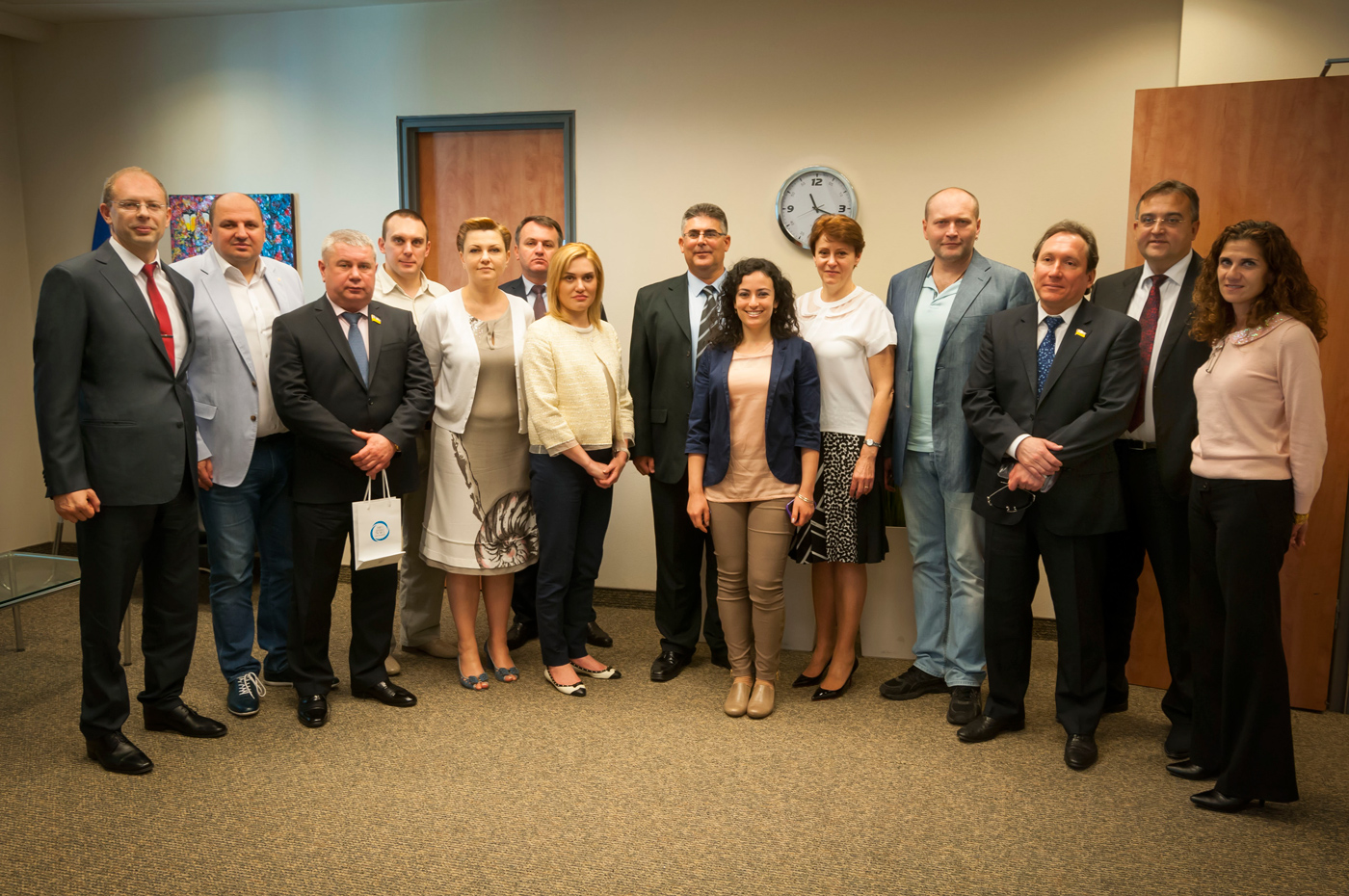
On behalf of the Honorary Consulate of Israel I would like to thank colleagues and representatives of the Israeli side for a productive visit and cooperation. The Ukrainian deputies were able to see everything personally, to see the customs, sea port, municipality, tax agency. I am sure that this experience will definitely help in the process of reformation in our country.

And today I want to tell you (for comparison) about a new environmental initiative, which was presented to the Knesset last week. The project "It's - my Earth" in the Israeli parliament was presented by the Israeli leaders of the environmental community, as well as the actors, poets, activists and parliamentarians. Like a hundred years ago, the Israelis are calling just to buy the land, which are on the brink of the ecological disaster. But if a century ago the lands were bought to build the life of the people of Eretz Yisrael, and now - to save the animals and plants.

The project offers on the base of crowdsourcing (when a large number of people are involved in a common affair who communicate with each other virtually) to associate with the global community and invites people to choose and buy a piece of land which is under the threat of ecological disaster place. It allows each resident to reduce the harm to ecosystems and to bring a contribution into the saving of the planet. The organizers want to attract the maximum number of participants into the project – the modern means of communication very well allow it. At the same time the authors of the idea coordinate their actions with the world's leading experts on environmental protection.

Now, actually, the comparison. According to the journalists of the Western regions of Ukraine, the region's daily output about 150 timber wagons. In support of my words - the bright picture of the state of the Ukrainian Carpathians.

Photo: "Zakarpatskii correspondent"

Tuesday, April 5, 2016

Greetings, friends!


At the end of the second day of the visit of the Ukrainian delegation in Israel we have already managed to meet with the experts in the field of finance, the Speaker of the Knesset, and yesterday we had a long and productive communication with the tax and customs control of Israel. We can say that it was an accelerated international course of experience exchange!

On April 4, the members of our delegation met with Uri Brook, a senior manager of tax administration of Israel and Sarah Beaton - the Head of the International Department of the Israeli Customs Administration. Before 2004, there were three tax units in Israel, which largely duplicated each other.

Realizing that the bloated apparatus of the tax service only hinders the process, the administration has been reduced to a single unit. As a result, a tax collection sharply increased and free staff were directed to new areas of work. So, in order to increase the collection of taxes in Israel they do not increase, but reduce the bureaucratic colossus.

In addition, Mr. Brook spoke in detail about how to work in Israel against the tax crimes, how to carry out the inspections in the companies, work with employers, etc. In general, there is a lot to learn.

Particularly, I will focus on the work of customs in Israel: according to the words of Ms. Beaton, 95% of all goods on the Israeli customs are reviewed for one hour. One hour! This occurs due to the usage of modern computer systems in the customs. It automatically analyzes the financial statements and helps the customs officers the best option behavior: whether to check the goods, or you can do a formal examination procedure. Such system works effectively because it takes into account every nuance of each client, the history of relations with him, the financial statements, etc. But you should note that in Israel seldom to whom will come to mind to give or accept a bribe for illegal trafficking: too long prison terms are threatening. Trafficking exists in Israel: every day the customs officers intercept weapons, drugs, cigarettes and tobacco.

Customs works very fast because almost all goods get customs clearance in advance, only 5% of goods are really testing to which there are any questions. The customs officials use special scanners in the work that test even very large container for a few minutes. There are also special "vacuum cleaners", which check the containers for weapons and explosives: the air takes the tests from the vacuum cleaner, and if it finds the slightest particle of explosive - the container is opened for inspection.

When an investor comes into the country, not only the tax and investment climate are very important in the region, but also the customs policy. A striking example - the company Intell, which invested $ 7 billion in the economy of Israel, because of the simplicity and transparency of the customs system of Israel, the company was able to bring quickly and easily the equipment to the country and start to work.

The final chord of the day was the visit to Ashdod where there is the largest commercial sea port in Israel. The Head of the customs control of the city, Rafi Gabay, said that the Israeli customs has very wide powers. In some moments more than the police. For example, according to the law only one person is free from customs inspections – it is the president. The customs has the right to check the goods even of any minister, including the Head of the government.

Later our delegation visited Ashdod City Hall: the Mayor, Yehiel Lasri, his deputy, Boris Giterman and a member of the City Council, who is responsible for education issues, Yehuda Frenkel, shared their experiences in the field of municipal management. The Ukrainian parliamentaries were told how the Israeli City Hall is organized, on what the municipality earns, what it manages, the challenges that are faced. In the process of decentralization, which Ukraine is helding, this experience is very useful.

P. S.: the Ukrainian parliamentaries passed the Mayor of the city Ashdod, Mr. Lasri, the map of the world from the children of Ukraine to the children of Israel in the framework of the action "Children are for peace all over the world".